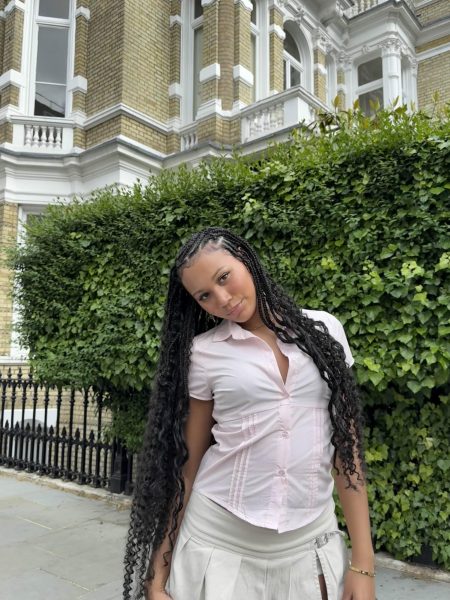
Hi! I’m Zora Por-Reinhardt, the current Opinions and Editorials Editor for The Pace Press. I am originally from Bergen County, New Jersey and am majoring in communications and media studies, with a minor in journalism. As my reign comes to an end, we are looking for new people to fulfill this editorial role! So prospective editors, let me walk you through the week in the life of the Op-Ed editor.
It’s Sunday night, otherwise known as pitching time! This is when you should be ready to send your pitches into the club’s Discord to prepare for Monday’s Pitch Meeting. When I first got this role, I enabled Google News notifications to stay updated with specifically political news and current events. Throughout the week, I get notified about events that may spark a strong student opinion, and I take note of it. And of course, social media like Instagram, Tik Tok and X gives insight into all the pop-culture drama and what people are saying about it. Following pop-culture developments through social media makes pitching easier, as seeing what either side of the general public has to say about an issue helps to form a pitch that invites writers to form an informed argument.
Pitches for the Op-Ed section can cover a range of topics, as long as it evokes a clear and strong stance. By Sunday night, I aim to develop around four to five relevant, yet not necessarily timely pitches. Timely topics would be a current event that is actively progressing or just happened. The timeline for editing and publishing articles that cover timely topics is shorter, usually by Friday of that week. However, if the topic discusses a more general topic, for example, arguing how constantly rotating micro-trends contribute to the climate crisis or rating the best coffee shops in the city, the editor can grant the writer more time to develop this article. Now rest up! We have a pitch meeting tomorrow!
As 12:15 p.m. on Monday rolls around, it’s time to head over to the meeting room. Each editor will be given time to present their pitches to the club. It is helpful to write down a little blurb about your pitch, bringing in some context surrounding the duality of the argument. This gives writers interested in the pitch an idea of what direction they can take the article into. Now, it’s time for pitches to be taken. You will meet individually with whoever took your pitch and get their contact information, and discuss the deadline. After the pitch meeting, it’s important to get in contact with the writer as soon as possible, so sending out an email that provides a general guideline for how to approach the article is the best way to initiate contact. This email will provide the deadline you both discussed, general structural guidelines. It’s also important to emphasize that an Op-Ed article is meant to be opinionated, and if the writer wants to take their argument in another direction than initially intended, that is okay.
The pitching portion of the meeting has come to an end, but the editor meeting has just begun. This time is where the editorial board discusses any upcoming events to plan for, updates on articles, and proposes new ideas for the club. If it’s a production week, we must plan for the in-print version of The Pace Press. For this, you should prepare a list of the most well-written, topical and interesting articles. During a designated production meeting, the articles chosen by each editor will be randomly assigned to other editors, for one final look-through. Moreover, you get to choose how your section will look, so if you want specific art or the articles to be ordered a certain way, include this in the organizational plan.
As the week progresses, I just check my email for any questions and updates, as well as noting any current event developments that I could pitch next Monday.
As Friday rolls around, this is when checking your email becomes vital, as oftentimes this is the deadline for articles to be submitted. Once you get the article, it’s time to start editing! Mainly, you are reading through for structural continuity, clarity, a strong stance and linked evidence. For grammar and structure, everything is outlined in The Pace Press AP style guide, which will be your best friend in this role! A key aspect about The Pace Press is constant writer/editor communication: after the first level of editing is complete, the article is sent back to the writer to accept or discuss the suggested edits and make any necessary changes.
After the writer has discussed and accepted the edits, the article is sent off to the Editor-in-Chief, who will make any final suggestions. Once all the t’s are crossed and i’s are dotted, the article is uploaded onto The Pace Press website.
Congratulations potential editor, you just finished a simulated week as the Op-Ed Editor. If you’re looking to improve your copy editing skills while being active in the University’s community by sparking debates and conversations about world events, then the role is for you. We would love you on our team!