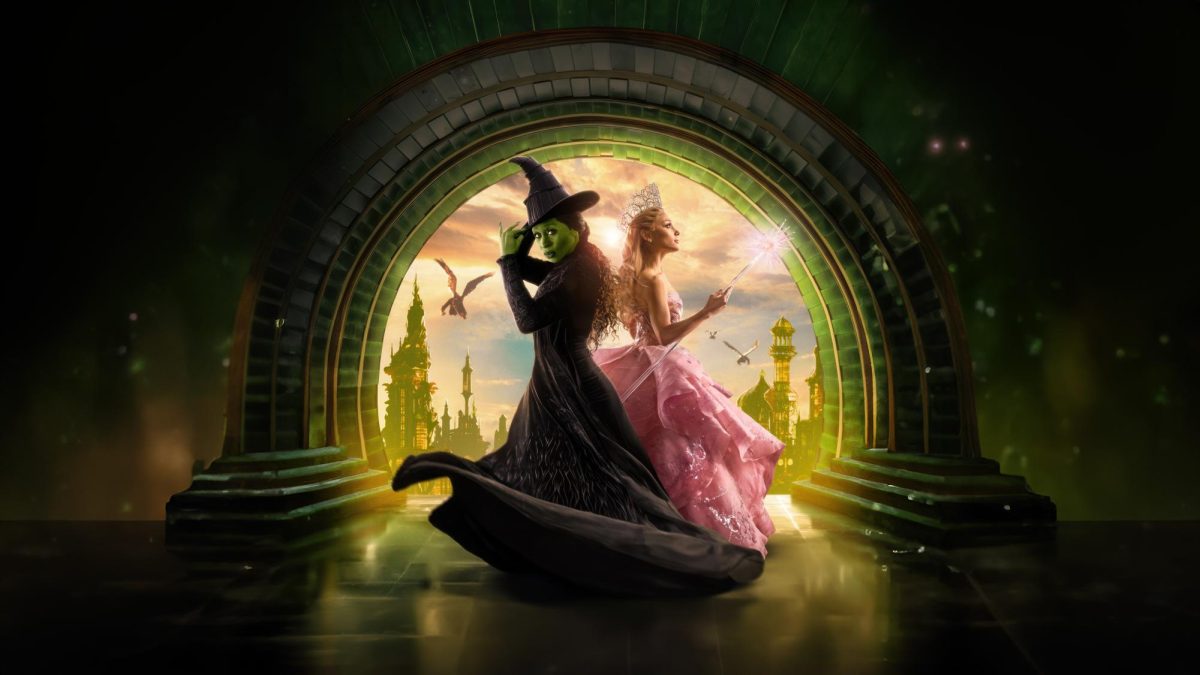
“Wicked: For Good,” the highly anticipated conclusion to Jon M. Chu’s two-part adaptation of the beloved Broadway musical, was officially released in theaters on Thursday, Nov. 20. Releasing almost exactly one year after its predecessor, the film primarily covers Act 2 of the stage musical, promising the epic conclusion to the long-beloved tale.
The film’s source material opened on Broadway in October 2003, to initially mixed reviews. Composed by legendary lyricist Stephen Schwartz (who returned to compose the score for both of Chu’s films) and written by Winnie Holzman, the original production starred Idina Menzel as Elphaba and Kristin Chenoweth as Glinda. 20 years later, though,
For many, “Wicked” (2024) was considered a great success. Likewise, for many, this past year has been spent in a rapturous state of anxiety, as viewers looked ahead to see whether or not Chu would be able to stick the landing, as it were.
Now, a year later, critics are mostly agreed that Chu has managed to do just that.
“Wicked: For Good” sees the main trio from “Wicked: Part 1”—Cynthia Erivo as Elphaba, Ariana Grande as Glinda and Jonathan Bailey as Fiyero—devolve into heightened states of emotional turmoil that they haven’t faced before. Set a year after the epic conclusion to the first installment, the film picks up with a bang. There is very little hand-holding, and the audience is trusted to be following along enough to understand the context of where the characters are in the story. It makes for a compelling reason to watch both parts back to back, as they symmetrically line up—just as Acts 1 and 2 would in the live performance.
Speaking of the performances, nearly every cast member goes above and beyond the skill and talent they displayed in “Wicked: Part 1.”
Cynthia Erivo outdoes the standard set by herself, blasting the roof off of her own performance of “Defying Gravity” with an earth-shattering rendition of “No Good Deed.” She continues to prove that she truly is the perfect Elphaba, and her portrayal of Elphaba’s more rebellious side is still very clearly rooted in hope and vulnerability. From the Wicked WItch’s moments of sheer range and grief to her quietest moments of softness, Erivo displays that she truly has a deep understanding of what was required of her. She is, without a doubt, the heart and soul of both films—and she carries that weight effortlessly.
Ariana Grande, while still employing her more pop-oriented vocal style, still measures up to the challenge of singing alongside longtime Broadway and West End alums like Erivo and Bailey. Nevertheless, her performance as Glinda slowly starts to understand her own complacency in the fascist regime—a thematic message that rings a little too true, in today’s day and age—and chooses to truly be good is incredibly impressive. Although much of the praise Grande received for “Wicked: Part 1” was in her comedic timing, she still shines, even when the material she’s working with is, without a doubt, more emotionally heavy.
Last but certainly not least, People Magazine’s newly-crowned Sexiest Man Alive lives up to that title. His approach to Fiyero, much like Grande’s to Glinda, takes on a more serious tone in this film. He is drawn with indecision for much of the film, caught between duty and devotion—displaying how his moral compass forces him to break out of the comfortable life he’s been living with incredible grace. He still captures Fiyero’s effortless charm, only adding the depth and emotion required to also portray his shifting beliefs as the oppression of the system he’s a vital part of begins to become too much to bear. That said, while he has less to do vocally in this film than its predecessor, he still matches Erivo’s energy to form a simply delightful rendition of “As Long As You’re Mine.”
Chu directs the project with a sense of magnetism and whimsy that is truly unparalleled, among movie musicals but also Hollywood in general. The five-year passion project comes across as just that—a duology made solely from love for “Wicked” and the story it tells. From Stephen Schwartz returning to not only compose the score for both films but to write entirely new songs for both Elphaba and Glinda to that iconic final shot (if you know, you know), Chu clearly displays a strong commitment to telling the original story as authentically as possible. The production design is a marvel to behold, especially on the big screen. Much like “Wicked: Part 1,” every shot bleeds with enough detail to make the diehard fans leave the theater feeling like they need to go back and rewatch the film to catch any easter eggs they might’ve missed as soon as possible.
Altogether, early critic reviews have been more mixed about this film than they were about its predecessor. While “Wicked” is currently sitting at an 88% Certified Fresh score on Rotten Tomatoes with a 95% Popcornmeter audience rating, “Wicked: For Good” currently only has a 67% from critics. Still fresh, but critics have not been quite as complimentary—name, as reviewer Jenn Adams puts it, “‘Wicked: For Good’ admittedly takes a while to get started and lacks the heft of the first film’s majesty, but it strikes a powerful emotional chord and provides a fitting end for beloved and iconic characters.” That said, “Wicked: For Good” currently has a higher audience score, at 97%. And as if that wasn’t enough proof of the film’s success, in its opening day, it earned over $30.8 million—the biggest box office opening of any film this year at the time of its release.
While “Wicked: Part 1” may currently be more beloved by critics, the overall consensus of the fans is that Jon M. Chu more than succeeded in telling the true story of the Wicked Witch of the West, conveying the original musical’s depth and the relationships at its core in a uniquely honest fashion. Or, to put it more simply—if you loved the first installment, you’ll love this one, too.
Rating: 4.5/5