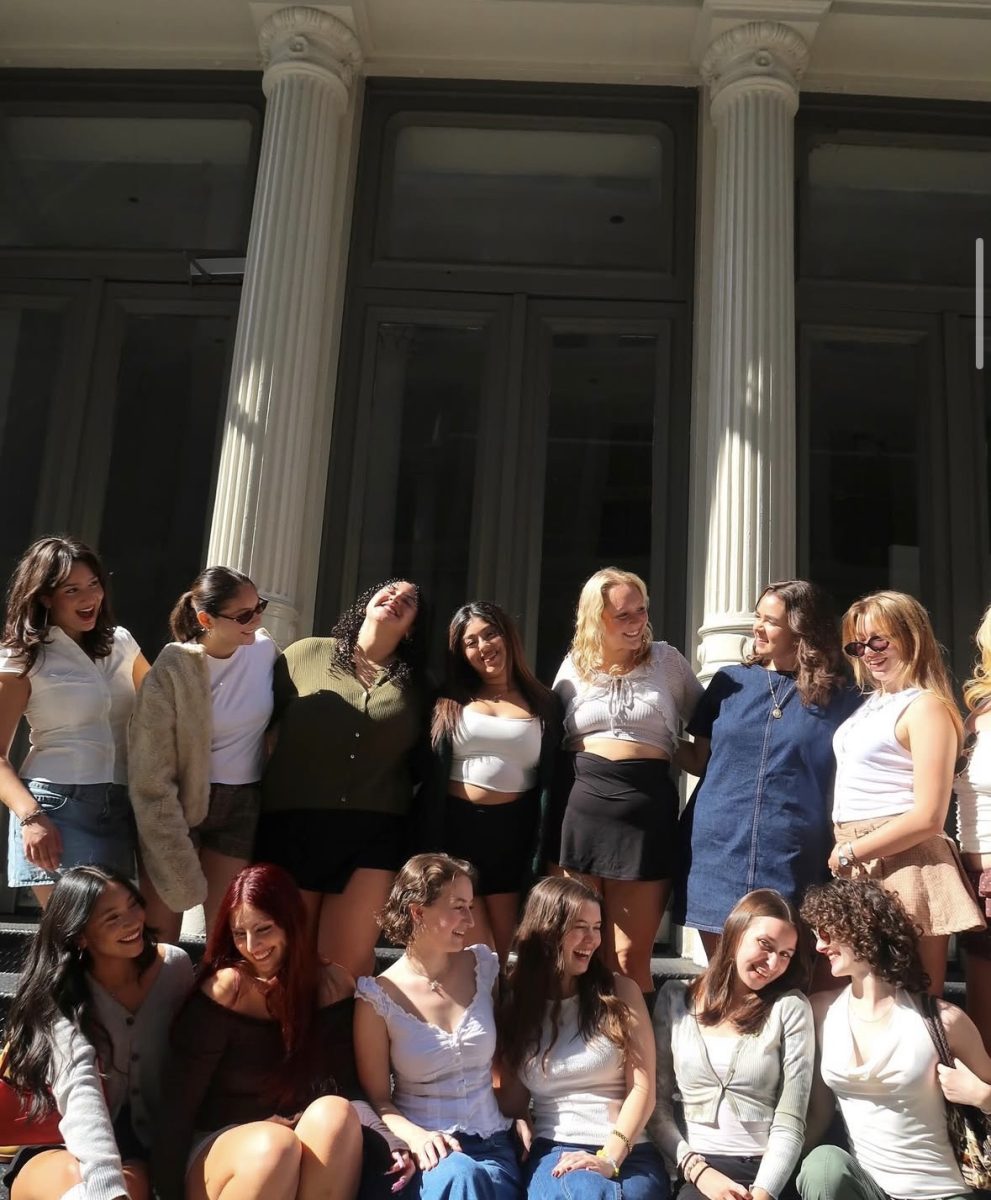
When people picture Greek life, many people’s minds go to South Eastherm Conference (SEC) culture and ‘Bama Rush’—so what happens when it exists not on a sprawling campus, but in the middle of downtown Manhattan? At the University’s New York City campus, there are two fraternities and four sororities: Zeta Beta Tau, Kappa Sigma, Kappa Delta, Phi Mu, Sigma Delta Tau and Alpha Kappa Alpha. These organizations operate without traditional housing or a central quad; instead, they plan events in campus spaces, online and across the city. Members organize philanthropy fundraisers, social gatherings and collaborative events with other organizations, using the city itself as part of their Greek experience.
For some students, Greek life doesn’t register as a major part of their college experience, or really part of the University experience at all. Zora Por-Reinhardt, a junior studying Communications and Media Studies, explained, “I don’t really think about them or know about them. I kind of wanted to join freshman year, but I had aversions because of stereotypes and because they seemed clique-y. That’s probably not true, but it’s how I perceived it.” She added that the city environment changes the atmosphere of Greek organizations. “They have a different role, I guess, since [the University] doesn’t have a traditional campus.”
This contrast between city-based and traditional Greek life is reflected in members’ experiences. Sorority leaders shared how participating in Greek life has shaped their college experience. Kappa Delta’s chapter president, Gianna Matteo, explained how Greek life provides a way to build community on a campus where students are spread across dorms, apartments and different commutes. With commuter students making up roughly half of the University’s population, many can feel detached from campus life. “Since we don’t have any sort of normal campus at Pace, it’s nice to be able to build community and see friendly faces all over campus,” she said. “We have a bunch of commuters and girls on campus, and it’s nice to be able to connect from all over the city.”
Phi Mu’s president, Kathleen Gattis, echoed the sentiment, noting that the absence of Greek housing doesn’t limit the chapter’s reach. She explained, “No one really expects a university in the city to have Greek life. Usually, when someone thinks of Greek life, they think of the houses right outside of campus. I would argue that being a part of Greek life in the city, in some cases, works to our advantage as we have the entire city at our disposal with so many opportunities for growth and outreach.” For Phi Mu, these opportunities often come through philanthropy and campus events. The sorority organizes programming for its national philanthropy partner, Children’s Miracle Network Hospitals, here in the city.
President of Alpha Kappa Alpha Sorority, Inc., Nia James, shared similar thoughts, explaining that Greek life in the city feels different due to the nonexistence of Greek housing. She said, “We build our connections in other ways,” sharing how living together is not a requirement for this sisterly connection. She focuses on the connection not only within her chapter, but with other chapters across the city and non-affiliated students. She shared her excitement for AKA’s upcoming Walk for Breast Cancer, supporting the American Cancer Society, which will feature her chapter, AKA chapters across the city, and plenty of students from all around New York.
Kappa Delta is preparing for “Pie a Brother/Sister,” a collaborative fundraiser with Zeta Beta Tau, where students can pay to toss a whipped-cream pie at fraternity and sorority members. For participants, these events are more than just lighthearted fun—they raise money for causes and foster connections across organizations. Matteo said Kappa Delta will donate their proceeds from the event to their local philanthropy, the New York Society for the Prevention of Cruelty to Children.
As Por-Reinhardt discussed, the decision to join can feel daunting at first. Phi Mu’s president admitted she was hesitant her freshman year. “I did not know what to expect and didn’t know if it would be for me,” she said. “After joining Phi Mu, I learned so much about myself as a person and a leader, and I am now the president of our chapter.” Kappa Delta’s president agreed, explaining that she had never imagined being in a sorority, but is grateful she joined.
Greek life can often get a poor reputation for its exclusive roots. Even today, white students make up over 70 percent of Greek life nationally, and a Princeton study showed 95 percent of Greek life members were from the wealthiest quarter of Americans. Leaders of Greek organizations at the University seek to challenge these historical patterns.“Something I wish people understood about Greek life at [the University] is that it is not exclusive, and anyone is able to join,” Gattis described. “Each organization has something different to offer, and the right one for you will give you the best experience possible.” While Greek life may not be the right fit for every student, members describe it as a way to create connections, participate in campus activities and develop leadership skills that might not otherwise be available.
These efforts toward inclusion are especially reflected in organizations like Alpha Kappa Alpha, which adds important diversity and history to the University’s Greek community. Founded at Howard University in 1908, Alpha Kappa Alpha was established as the first historically Black sorority. More than a century later, Alpha Kappa Alpha has grown to have over 380,000 members, symbolizing the inclusive growth in the national Greek community. The lasting legacy of AKA demonstrates how the community may keep its roots in tradition while continuing to evolve.
Whether fully embraced or just something you notice on a flyer while waiting for the elevator, Greek life at the University offers a distinctly urban experience that reaches beyond campus walls. Matteo shared that attending the Kappa Delta convention allowed her to meet people from across the country she never expected to connect with, an experience she wouldn’t have had if she hadn’t tried something new. While Greek life may not be for everyone, it offers a chance to meet new people, get involved and experience something different in the city that never sleeps.