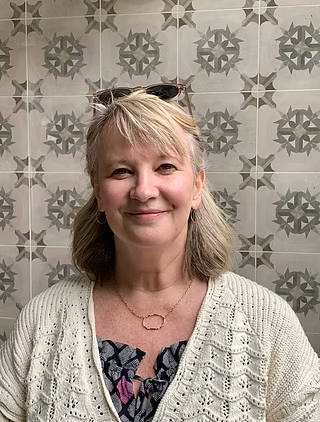
As one of the co-department chairs of the English department at the University, Sid-Ray has a lot of insight on the happenings of the department. She is a professor of English and women’s gender studies with a focus on Shakespeare and other early modern playwrights. Previous Kenan award winner for excellence in teaching, Sid has also recently received the Undergraduate Research Mentor of the Year award in 2024. I had the honor of sitting down and having a conversation with Professor Ray, where we discussed her path to Pace, and the English department.
Q: Tell me a little bit about yourself, who are you, what is your role at pace?
A: In the early 2000s, I was hired to teach Shakespeare for the most part, but with expectations to teach intro to composition and ESL. Through the years I now focus on teaching literature and then took on some roles as associate chair for many years. Now I am co-chairing the English department with Stephanie Hsu.
Q: Why Pace?
A: This is a funny story. When I was on the job market, having just received my PHD, I really wanted to be based in New York. When I went to the national conference for my field in L.A. I stepped on a piece of paper on the floor, and it was a job ad for Pace. I picked it up and thought ‘I should apply for this’, I was lucky enough to get offered the job! The fun fact is that the GRD exam, which I took to get into grad school, was actually at Pace, and I ended up working here.
Q: What inspired you to become an English professor?
A: This is another full-circle story. I am a nepo baby. My father was an academic for 45 years in the same field as me. He is also a Shakespeare scholar. I grew up on a college campus, I just love the life! I feel like college campuses are my home, I’m privileged to have grown up on a college campus. That’s how I made it here!
Q: How have you incorporated your love for Shakespeare into your teaching?
A: In all the ways! Shakespeare can be really intimidating to people. It can be such a barrier, because the language is so old-fashioned. I’ve always been of the mindset of making Shakespeare accessible. We look at the forces that aligned for him to write the plays that they wrote. One of the ways I teach is by putting the plays on their feet. I like to see it as they’re collaborating with Shakespeare, they’re co-writers.”
Q: I read you were the co–principal investigator on The Ground Beneath Our Feet project, can you explain that further?
A: In summer of 2020, when George Floyd was murdered, there was a big reckoning among white academics, where we looked into our hearts and realized we were not doing enough. I was like “Gosh I teach Shakespeare, the whitest of white guys.” I thought, “what can I do?” I was doing research and came across this story of the African company, a group of black theater entrepreneurs and actors who took it upon themselves to perform Shakespeare in lower Manhattan. I realized they actually performed right at the footprint of Pace. This completely blew my mind. I also realized this was not my story to tell. Kaylee Ladle, she and I worked together to develop this project that later got funded. She did 3 projects, and she ended up being a Charles Dyson award winner. I always attribute to her that she was one of the founders of the ground beneath our feet. Literally right below our feet are layers of history that go untold, mostly stories of indigenous, black, LGBTQ. Stories of people who are not usually highlighted in the stories we tell.
I got together with Kelley Kreitz and Maria Iacullo-Bird, and got this very nice government grant, to help us continue experiential learning at Pace. We were a year into it when it was rescinded by Doge and the Trump administration. But we refuse to be defeated, and we carry on! We use our resources at Pace to do what we can.
Q: What are the biggest misconceptions about English majors?
A: The biggest misconception is that we cannot get jobs and make as much money as the other majors. However— and this is documented— we make the same amount of money as anyone in science and in business. Even if we do make less— which we don’t— our lives are enriched by the culture that we study and engage in. We’re happy people.”
Q: Is there anything specific you would like to bring to attention in this interview?
A: I would like to say I’m really proud of my colleagues in the English department. I feel a strong sense that my colleagues are brilliant, both as teachers and scholars. I kind of want to take their classes! My co-chair and I, Stephanie, sat down and listed everything we do. And there was so much. We give out 25,000 dollars in writing awards to students. We have partnerships, dedicated paid internships, we have our various programs, ground beneath our feet and the Archipelago’s grant. We have partnerships with New York city schools, Cosmic writers which give public schools enrichment, and our Pace students paid work. We do so much with so little, and I’m so proud of that.